Hot Flash SOS
What actually works now — and what you can stop wasting money on
By Delaney Cassidy
It starts in your chest.
A flicker of heat, and then — before you can do a single thing about it — a wave climbing your neck and face like something spilled. Your heart is going. Your scalp is damp. You can feel the sweat gathering at the small of your back, under a blouse you chose specifically because it would not show it.
And you are in a meeting. Or a restaurant. Or standing at the front of a room, mid-sentence, with people watching your face flush and knowing exactly what is happening to you.
You try to keep talking. You try to look like a woman who is not on fire.
And then, at two in the morning, you wake in sheets so soaked you have to change them — and lie there in the dark, cold now, doing the arithmetic of how many hours you have left before you have to be a professional again.
It was never “just a hot flash.” And you do not have to endure it.
Here is what almost nobody tells you: about 80% of women experience hot flashes. And only around 20–30% ever receive treatment for them.
Not because treatment does not exist. Because nobody told them it did.
So this article is going to tell you. All of it — what a hot flash actually is (it is not what you think), what genuinely works now (including two drugs that did not exist a few years ago), what to stop wasting your money on, and what you can do tonight while you wait for an appointment.
First: a hot flash is not a heat problem. It is a brain event.
This is the single most misunderstood thing about hot flashes, and understanding it changes how you think about treating them.
Deep in your brain sits the hypothalamus — your body’s thermostat. It maintains something researchers call your thermoneutral zone: a comfortable band of core temperature within which your body does not need to do anything. Above it, you sweat and flush to cool down. Below it, you shiver. In between, you simply exist without thinking about it.
Now: a specific cluster of neurons in that thermostat — they are called KNDy neurons — are regulated in part by estrogen. When estrogen withdraws, those neurons become hyperactive, and they flood the thermoregulatory center with signalling chemicals called neurokinins.
The consequence is precise and cruel: your thermoneutral zone collapses.
The comfortable band narrows so drastically that a rise in body temperature far too small for anyone else to notice — a warm room, a cup of tea, a flicker of stress, a duvet — crosses your threshold and triggers a full emergency cooling response.
Blood vessels dilate. That is the flush. Sweat glands open at scale. That is the drench. Your heart rate climbs. That is the pounding. Your body genuinely believes it is overheating and is doing everything in its power to save you.
You are not weak. Your brain’s thermostat is misfiring — and it is doing so because of a mechanism scientists can now name, target, and switch off.
That last part matters enormously. Because once researchers identified the neurokinin pathway, they could build drugs that block it. And they did.
How long does this last? (Brace yourself, then keep reading.)
The SWAN study — the largest and longest study of the menopausal transition ever conducted — followed thousands of women for years. Its finding on duration is not what most women are told.
The median duration of frequent hot flashes was roughly seven and a half years. For women whose symptoms started early — before their periods became irregular — it was longer, often ten years or more. And duration varied significantly by group, with Black women experiencing symptoms for the longest, a median of around a decade.
Ten years. Not “a few bad months.” Not “it will pass by Christmas.”
Which is exactly why “just ride it out” is not medical advice. It is a decade of your life.
What actually works — in order of effectiveness
The treatment landscape has changed more in the last three years than in the previous thirty. Here is the honest hierarchy.
1. Menopausal hormone therapy — still the most effective treatment there is
Let us be clear about this, because a generation of women were frightened away from it: hormone therapy remains the most effective treatment for hot flashes. Nothing else matches it.
The fear came from the 2002 Women’s Health Initiative coverage, which was widely reported as showing that hormone therapy was dangerous. Prescriptions collapsed. Doctors stopped offering it. Women suffered for two decades.
That picture has been substantially revisited — the risks were considerably overstated for healthy women under 60 and within ten years of menopause — and the FDA has now removed those long-standing boxed warnings. The agency began the process on November 10, 2025, and approved the first labeling changes in early 2026, with more products following. (One caveat, because we don't do half-truths: the boxed warning for endometrial cancer on estrogen-alone products was not removed — it stands.)
It is not right for everyone. Roughly 9% of U.S. women have a genuine contraindication, and some women simply prefer not to take it. But if you were told twenty years ago that hormones were off the table, that information is out of date, and you are entitled to a fresh conversation.
2. The new non-hormonal drugs — this is the part that is genuinely new
Remember the neurokinin pathway? Two drugs now block it. They are not antidepressants repurposed. They are not herbal. They target the actual mechanism of the hot flash.
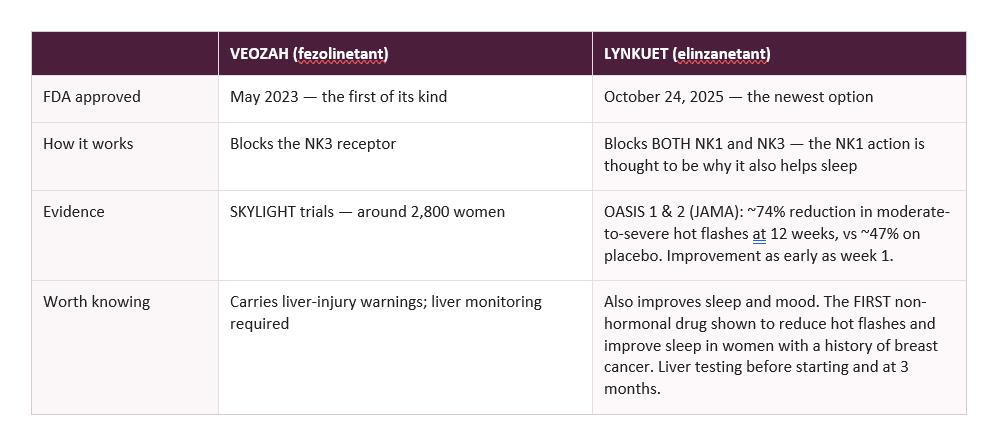
New, Non-Hormonal Drugs
Why this matters so much: if you have had breast cancer, or you have another reason you cannot take estrogen, you were until recently offered very little. That is no longer true. These are not consolation prizes — they are effective, FDA-approved medicines that target the root mechanism, and elinzanetant can be used first-line. As always, make an informed decision with your doctor and understand the side effects.
3. Other prescription options
● Paroxetine (Brisdelle) — a low-dose SSRI and the only one FDA-approved specifically for hot flashes (2013). Modest but real benefit.
● Gabapentin — used off-label; can be particularly useful for night sweats, since it is sedating.
● Oxybutynin and clonidine — also used off-label with some evidence, though side effects limit them for many women.
4. Cognitive behavioural therapy — yes, really, and here is why
Before you roll your eyes: CBT does not stop the hot flash. What the evidence shows is that it markedly reduces how much they bother you — the distress, the anticipatory dread, the sleep disruption that follows one. Given that the misery of a hot flash is largely in its interference with your life, that is not a small outcome. It is recommended by menopause societies precisely because it works, and it has no side effects at all.
What to stop wasting your money on
The menopause supplement market is enormous, largely unregulated, and built on exactly the vacuum we have been describing all month: nobody funded the research, so nobody could give women answers, so an industry rushed in to sell them hope by the bottle.
Here is the honest accounting.
● Black cohosh — the most popular herbal remedy, and one of the most disappointing under rigorous testing. It beat placebo in only a small minority of well-designed randomized trials. Rare cases of liver toxicity have been reported.
● Soy isoflavones — inconsistent. A subset of women may respond — possibly those who can convert isoflavones into equol, a more estrogen-like compound — but there is no easy way to know whether you are one of them without trial and error.
● Evening primrose oil — no convincing evidence for hot flashes. It is one of the most-sold and least-supported products in the aisle.
● “Bioidentical” compounded hormones — be careful here. FDA-approved hormone therapy IS available in bioidentical forms. What menopause societies warn against are CUSTOM-COMPOUNDED preparations, which are not FDA-regulated, not tested for consistency of dose, and often sold with dramatic claims and salivary hormone testing that means very little.
The rule for the entire aisle: if a product promises what the peer-reviewed research has not delivered, ask who paid for the study. The vacuum created by underfunding is exactly where the profit is.
What you can do tonight, while you wait for an appointment
Appointments take weeks. None of this replaces treatment — but all of it helps, and it costs nothing.
Become the detective: map your triggers for two weeks
Your triggers are yours alone, and once you can see them you can outmanoeuvre them. For fourteen days, log the time of each flash, what you ate or drank in the preceding hour, your stress level, what you were wearing, and the temperature of the room.
The usual suspects: alcohol (particularly red wine), caffeine, spicy food, hot drinks, warm rooms, stress, smoking, and tight synthetic clothing. Most women find two or three reliable triggers — and are astonished, because they had never connected the pattern.
Engineer your environment
● Layers, always — natural fibres, so you can shed rather than endure.
● A cool bedroom, a fan aimed at the bed, and a glass of ice water within reach at night.
● Cooling pillow, moisture-wicking sleepwear, and a second set of sheets within arm’s reach so a 2 a.m. change takes ninety seconds and not twenty minutes.
● Paced breathing at the first flicker — slow, deep, six breaths a minute. It will not abort every flash, but it reduces the panic that amplifies it.
Two things with real evidence behind them
● If you smoke, stopping helps. Smoking is consistently associated with more frequent and more severe hot flashes.
● If you carry excess weight, losing some can reduce symptom burden — fat tissue affects thermoregulation and hormone metabolism. This is offered as information, not as blame: it is one lever among many, and it is not the whole story.
The bottom line
Eighty percent of women go through this. Fewer than a third are ever treated for it. And the gap between those two numbers is not made of medicine — it is made of silence.
You have real options. Hormone therapy is more available than you were told. Two drugs now exist that target the precise brain mechanism causing your hot flashes — and one of them did not exist two years ago. There are prescription alternatives, an evidence-based therapy, and a whole set of things you can do tonight.
What you do not have to do is grit your teeth for a decade and call it dignity.
You are not weak. Your thermostat is misfiring. And that is a medical problem with medical answers.
Take the free 7-Day Symptom Tracker + Doctor Visit Guide from HERE into your next appointment — and ask, by name, about the options above.
You’re not crazy. You’re not alone. And you were never meant to just endure this.
— Delaney
SOURCES & REFERENCES
4. Elinzanetant (Lynkuet): dosing, liver monitoring, and use after breast cancer — Breastcancer.org
5. Fezolinetant (Veozah, Astellas) — FDA approved 2023; SKYLIGHT 1, 2 and 4 trials
6. Comparison of the two NK receptor antagonists — receptor binding, efficacy, safety
8. The Menopause Society — nonhormone therapy position statement and certified practitioner directory
9. FDA action on menopausal hormone therapy labeling (2025)
Note: this article names specific prescription medicines because women are entitled to know they exist — not to recommend one for you. Every drug here carries its own risks, contraindications and monitoring requirements (both NK antagonists require liver testing). Hormone therapy remains the most effective treatment for hot flashes but is not appropriate for everyone. These decisions belong with a menopause-trained provider who knows your history. All figures verified against primary sources before publication.