The part of menopause nobody warns you about, and why it might be the most honest chapter you get.
You’re standing in the doorway of a bedroom that used to be loud.
The bed is made. The posters are down. The closet is half empty. The house is quiet in a way it hasn’t been in decades, and you’re crying into a laundry basket.
Not because you aren’t proud. You are. You did the job. But somewhere between folding the towels and turning off the light, a question slides in sideways and won’t leave:
Who am I now?
Maybe for you it isn’t an empty bedroom. Maybe it’s a job that suddenly feels like it belongs to someone else. A marriage that shifted gears. A mirror that shows a woman you’re still getting to know. Or nothing on the outside at all, just a strange, flat blankness where your sense of yourself used to be.
If you’ve felt it, I want you to hear this first: you’re not having a crisis of character. You’re in the middle of one of the biggest transitions a woman’s body and life go through, and almost nobody told you this part was coming.
Key takeaways:
– Estrogen affects mood, memory, and stress response, so identity and mood shifts in midlife are partly biological.
– Perimenopause often coincides with role changes (empty nest, caregiving, career shifts), so body and life change at once.
– The losses of this season (fertility, familiar body, roles) are real grief and deserve respect.
– Asking “who am I becoming?” works better than chasing who you used to be.
– CBT is an evidence-based option for mood, sleep, and bothersome hot flashes. Persistent low mood deserves a provider visit.
Three things hitting at once
Here’s why this season can feel like the floor tilted.
Your hormones are changing the locks. Estrogen isn’t only about periods and hot flashes. It’s deeply involved in mood, memory, and how your brain handles stress. As it swings and falls, it stops reliably supporting the brain systems that keep you steady. That’s why so many women notice anxiety where there used to be calm, irritability that feels out of proportion, or waves of flatness when nothing is “wrong” on paper. It isn’t in your imagination: in a 2026 study in Menopause, perimenopausal women’s self-reported psychological symptoms were about 1.5 times more severe than premenopausal women’s. (It was app-based survey data from women who chose to take part, so read it as a strong signal, not the final word.)
Your roles are changing at the same time. For many of us, the empty nest, the aging parents, and the career plateau or pivot land right on top of perimenopause. That’s not bad luck. It’s timing. The years your body starts recalibrating are often the exact years your life does too.
And the culture hands you a script that says your value expires at 50. Nobody throws a party when your body decides it’s done making babies. There’s no ritual. No menopause shower. Just a quiet, private sense of loss, and a world that acts like you’re supposed to fade politely into the background.
Body, mind, and circumstances, all at once. Of course it feels like you’ve lost the thread.
The grief nobody names
Let’s say the quiet part out loud, because naming it takes some of its power away.
This season often comes with real losses:
• The loss of fertility, even if you weren’t planning on more children
• The loss of a familiar body and predictable moods
• The loss of energy, libido, or sleep that used to come easily
• The loss of a role that organized your whole day, and maybe your whole identity
That’s grief. Real, valid grief. It deserves the same respect we give any other kind of loss. You’re not being dramatic. You’re not “too sensitive.” You’re responding, honestly, to real changes in your biology and in your life.
And here’s what makes it heavier: the system didn’t prepare you for any of it. It didn’t teach you what this would feel like. It didn’t fund the research to ease it. It didn’t train most doctors to recognize it. So you’ve been carrying it alone and wondering why it’s so hard.
It’s hard because nobody helped. Not because you’re weak.
What my mother taught me without saying a word
My mother raised six children. Eight pregnancies, six kids, and a house that was never quiet. Being a mom wasn’t just something she did; it was who she was, and she was extraordinary at it. Need dinner? There was always more than enough. Need advice? She had plenty, and it was good.
When my youngest brother left home, the house wasn’t just empty. It was silent. The kind of silent that swallows you when you’ve spent decades inside constant, beautiful chaos. I watched it hit her. Nobody talked to her about perimenopause. Nobody connected her sleeplessness, her sadness or her disappearing sense of self to what was happening in her body. She worked her way through it the way women always have: quietly, and mostly alone.
And then she found her new calling.
She started combing the daily and Sunday papers for recipes she knew her family would love. She typed them up on a hand-me-down computer, slid them into protective sheets, sorted them by category, and handed each of us a three-inch binder with dividers. At every family event, she’d bring the latest additions. Some of them have her notes in the margins.
Those binders are among the most treasured things any of us own.
She didn’t get her old life back. She built a new one out of what she knew, what she loved, and who she’d always been underneath the role. That’s the whole lesson, and it took me years to see it.
The trap: chasing who you used to be
I know this blankness myself. During the hardest stretch of my career, I went through the only bout of depression I’ve ever had, and for a while I couldn’t find the woman I used to be. The capable one. The one who always knew what came next.
The temptation, when you don’t recognize yourself, is to chase her. To white-knuckle your way back to the old energy, the old body, the old version of you that everyone knew.
The temptation is to chase who you used to be. The opportunity is to ask who you’re becoming.
Grab a notebook and try these three questions. No grades, no right answers:
1. What do I miss about myself?
2. What parts of me am I discovering now?
3. Who do I want to become, now that I know myself better?
That last one is the one that changes things. Because you do know yourself better. You’ve got decades of evidence about what you can survive, what you care about and what you’re done tolerating.
You’re not starting from scratch. You’re building on everything you’ve already lived.
Rewrite the story you’re telling yourself
The stories we tell ourselves in this season tend to sound like obituaries. They don’t have to.
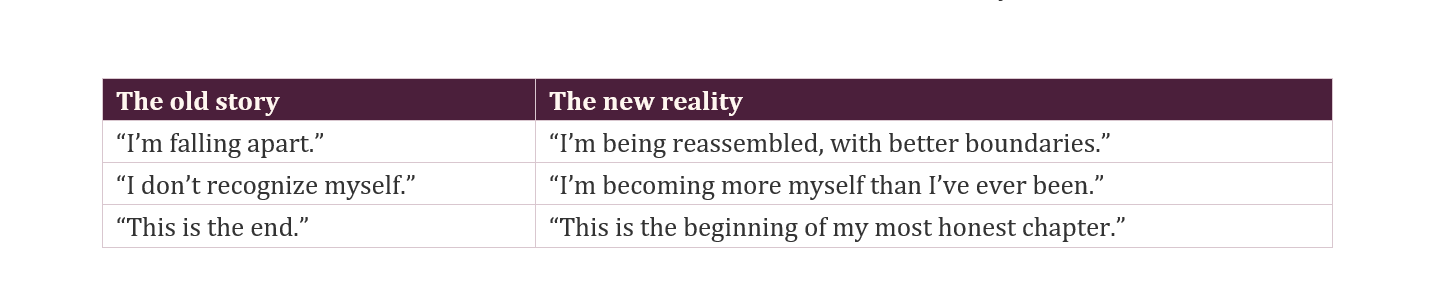
Reimagine your story…
You’re allowed to grieve and grow at the same time. One doesn’t cancel the other.
Small moves that rebuild you
Reinvention doesn’t have to mean moving to Portugal or changing your name. (Though if that’s calling you, go.) It’s usually quieter and steadier than that.
• Reclaim your time. Look at your calendar with clear eyes: what drains you, what restores you, what can go? Protect even 30 minutes a week that belongs only to you.
• Use your voice 10% more. Where are you biting your tongue to keep the peace? Try saying “no” to what drains you, “yes” to what restores you, and “not anymore” to roles that only worked when you ignored yourself.
• Remember your skills. List the things you’ve done that took courage, brains, or sheer endurance. You didn’t lose those capacities. You’re meeting them in a new season.
• Try something that feels “too late.” A class. A trip. A new style. Singing in the car with the windows down. Joy is not a reward for finishing your to-do list.
• Get real support for your mind. Cognitive behavioral therapy (CBT) is a structured, evidence-based talk therapy for anxiety and low mood. The Menopause Society recommends CBT as a non-hormone option for bothersome hot flashes, and CBT for insomnia (CBT-I) is a recommended first-line treatment for chronic insomnia. It won’t change who you are. It changes how your brain responds to what’s happening.
When it’s more than a rough patch: if low mood, hopelessness, or loss of interest lasts more than a couple of weeks, or starts getting in the way of your life, tell your provider. Perimenopause can cause real depression, and you deserve real care, not a pep talk. If you’re ever in crisis, call or text 988 in the US, or your local emergency number.
This was never just about you
If this season has left you feeling dismissed, invisible, or quietly lost, that is not a verdict on your strength. It’s the predictable result of a system that never invested in women’s midlife: not in the research, not in the training, not in the rituals that other cultures built around this exact transition.
You can’t meditate your way out of decades of underfunded research. But once you see the system clearly, something shifts. The shame lifts, because it was never yours to carry. And what’s left is a woman with more experience, more clarity, and more permission than she’s ever had.
My mother found hers in three-inch binders. You’ll find yours somewhere too.
You’re not fading. You’re becoming.
Want the whole story?
This piece is adapted from Chapter Three and Chapter Nine of my book, You’re Not Crazy... You’re Menopausal: Science, Strategies, and Swearing Through the Hormonal Apocalypse. Chapter Nine goes deeper: the scripts for reclaiming emotional space, how CBT and clinical hypnosis can help, breathwork you can use in the middle of a hot flash, and the full Midlife Reinvention Map. It’s out now at notcrazymovement.com/book.
And if you want to start by getting clear on what your body is doing, grab the free 7-Day Symptom Tracker + Doctor Visit Guide at notcrazymovement.com. It turns “I don’t feel like myself” into evidence you can take to your next appointment.
You’re not crazy. You’re not alone. And this chapter belongs to you.
— Delaney
Delaney Cassidy is the author of You’re Not Crazy... You’re Menopausal: Science, Strategies, and Swearing Through the Hormonal Apocalypse, out now at notcrazymovement.com/book.
Medical note: This article is educational and is not medical advice. Mood changes in midlife can have many causes, including thyroid disease, anemia, depression, medication effects, and more than one can be present at once. Please talk to a provider who knows your history before starting, stopping, or changing any treatment. If you’re in crisis, call or text 988 (US) or your local emergency number.
-
Losing your sense of self in midlife is common and real. Falling, fluctuating estrogen affects mood and stress, and it often coincides with major role changes like the empty nest. Add a culture with no rituals for this stage, and identity grief follows. It’s a transition, not a failing.
-
Yes. Many women describe a blankness or identity loss in midlife. Hormonal changes affect mood and stress, and they often arrive alongside big life transitions. It’s a recognized pattern, not a personal failing.
-
It can. Fluctuating estrogen can disrupt the brain systems that regulate mood. If low mood, hopelessness or loss of interest lasts more than a couple of weeks, talk to your provider.
-
Often, yes. For many women, children leave home during the same years when perimenopause begins, so hormonal changes and identity shifts hit at once.
-
Reflective questions (what do I miss, what am I discovering, who do I want to become), protecting time for yourself, using your voice more, trying new things, and evidence-based support such as CBT.
-
Yes. CBT is evidence-based for anxiety and low mood. The Menopause Society recommends it as a non-hormonal option for bothersome hot flashes, and CBT-I is a first-line treatment for chronic insomnia.
-
Chapter Nine of You’re Not Crazy... You’re Menopausal covers mindset, identity, and reinvention in depth, with scripts, CBT, clinical hypnosis, breathwork, and the Midlife Reinvention Map.
Sources & References
1. Cassidy D. You’re Not Crazy... You’re Menopausal: Science, Strategies, and Swearing Through the Hormonal Apocalypse. The Not Crazy Movement; 2026. Chapters Three and Nine.
2. Menopause (The Menopause Society), 2026: Flo app analysis, n≈7,975, 20 countries. Perimenopausal Menopause Rating Scale psychological score 7.3 vs 4.8 premenopausal (about 1.5×). Self-selected, self-reported. (Canonical Stat Sheet v2.4.)
3. The 2023 Nonhormone Therapy Position Statement of The North American Menopause Society. Menopause. 2023;30(6):573–590. (Recommends CBT and clinical hypnosis for vasomotor symptoms.)
4. Qaseem A, et al. Management of Chronic Insomnia Disorder in Adults: A Clinical Practice Guideline From the American College of Physicians. Ann Intern Med. 2016;165(2):125–133. (CBT-I as first-line treatment.)