Is It Anxiety or Perimenopause?
How to Tell the Difference — and What to Do About It
By Delaney Cassidy
It is 3:14 in the morning.
Your eyes snapped open a few minutes ago and your heart is going like you have just sprinted up a flight of stairs. Nothing happened. There is no noise in the house, no bad dream you can remember. But your chest is tight and there is a metallic hum of dread sitting just under your ribs, and your brain has already started scrolling — the email you should have answered, the thing you said in the meeting, the appointment you forgot to make, the way your body doesn’t feel like your body anymore.
You lie there and do the math on how many hours are left before the alarm. You will be exhausted tomorrow. You were exhausted today.
And somewhere in that long dark stretch, the thought arrives that scares you more than any of it:
What is wrong with me?
So eventually you go to a doctor. You describe the racing heart, the dread, the irritability that has you snapping at people you love. You are articulate about it, because you have had a lot of 3 a.m.s to rehearse. And you walk out fifteen minutes later with a diagnosis of anxiety and a prescription you are not entirely sure you need.
Here is what nobody told you: it might not be anxiety. It might be perimenopause. And the difference changes everything about what actually helps.
This piece is going to give you the whole thing — what is actually happening in your brain, how to tell the two apart, a self-assessment you can score in five minutes, and the exact words to say at your next appointment so you are not waved out the door. Bookmark it. You are going to want it in front of you when you go.
First: what is actually happening in your brain
Most women are handed some version of “your hormones are changing” and sent on their way. That is not an explanation. It is a shrug with a lab coat on. So let us do this properly, because once you understand the mechanism, everything you have been feeling stops being mysterious and starts being logical.
Estrogen is a brain hormone
We are taught to think of estrogen as a reproductive hormone — the thing that runs your cycle. That is a fraction of the job. Estrogen receptors are distributed throughout the body: the brain, the heart, the blood vessels, the bones, the skin, the bladder, the gut. Your brain is dense with them.
Inside the brain, estrogen behaves like a stagehand who quietly keeps the whole production running. It supports the production and activity of serotonin — the neurotransmitter most associated with mood stability. It interacts with GABA, the brain’s primary calming signal, the one responsible for taking your foot off the gas. It modulates norepinephrine, which governs alertness and the fight-or-flight response. It influences dopamine, motivation, and reward. And it plays a role in how the amygdala — the brain’s threat-detection center — decides what counts as an emergency.
Now take that stagehand away, unpredictably, for years.
The part almost nobody tells you: it is the fluctuation, not the decline
Here is the single most useful thing in this article, and it is the thing women are almost never told.
If perimenopause were a smooth, gradual descent of estrogen — a gentle ramp down — your brain would adapt. Brains are good at adapting to steady change. But that is not what perimenopause is.
Early perimenopause is characterized by volatility. Estrogen does not glide downward; it spikes and crashes, sometimes reaching levels higher than you had in your thirties, and then dropping hard. Your brain is being asked to recalibrate to a moving target — over and over, month after month, sometimes week to week. That is why so many women report that the years before their periods stop were far worse than the years after. It is not because they lost more estrogen. It is because the estrogen they had would not sit still.
Your brain is not failing. It is trying to hit a target that keeps moving.
And when serotonin support wobbles, mood wobbles. When GABA signaling is disrupted, the brake pedal gets soft — you cannot calm yourself down the way you used to. When norepinephrine is unmodulated, the alarm system fires easily and loudly. When the amygdala is less regulated, ordinary things start registering as threats. A full inbox feels like a crisis. A change of plans feels like an ambush.
Add the second engine: cortisol. Falling estrogen means less buffering of your stress response, so cortisol — your primary stress hormone — runs higher and stays high longer. Cortisol has a natural rhythm; it is supposed to dip at night. When it does not, you wake at 3 a.m. with your heart pounding. And because poor sleep raises cortisol the following day, you now have a loop that feeds itself.
So look at what you actually have: a brain with less serotonin support, a weakened calming signal, an over-eager alarm system, and a stress hormone that will not switch off at night.
That is not anxiety as a personality trait. That is a neurochemical situation. And you did not cause it.
And this is where the newest research becomes almost satisfying to read — because someone finally went and measured it. In 2026, a global study published in Menopause, the journal of The Menopause Society, looked at self-reported data from nearly 8,000 women across 20 countries. Perimenopausal women's psychological symptoms — the anxiety, the low mood, the irritability, the mental exhaustion — scored about 1.5 times more severe than premenopausal women's. Not “a little worse.” Measurably, significantly worse, on the same scale, across six continents.
Read that again: the thing you were told to breathe through and manage with a better attitude is, on average, half again as intense as what you were carrying with ease a few years ago. You are not less resilient. The load got heavier.
The symptom map: what perimenopause actually looks like
Most women are waiting for hot flashes and missed periods — so when the symptoms show up in other forms, they never connect the dots. Perimenopause is associated with a long list of symptoms across multiple body systems, and it can begin as early as the mid-to-late thirties, often while your periods are still perfectly regular.
And the data backs this up in a way that still stuns me. When that same 2026 research looked at what women over 35 actually reported, the most common symptoms were not hot flashes at all. They were exhaustion (83%), irritability (80%), depressive mood (77%), sleep problems (76%), and anxiety (75%). Hot flashes — the one symptom everyone is trained to watch for — came in well down the list. No wonder so many of us never connected the dots. We were all handed the wrong picture.
Here is what it can look like when it has nothing to do with hot flashes.
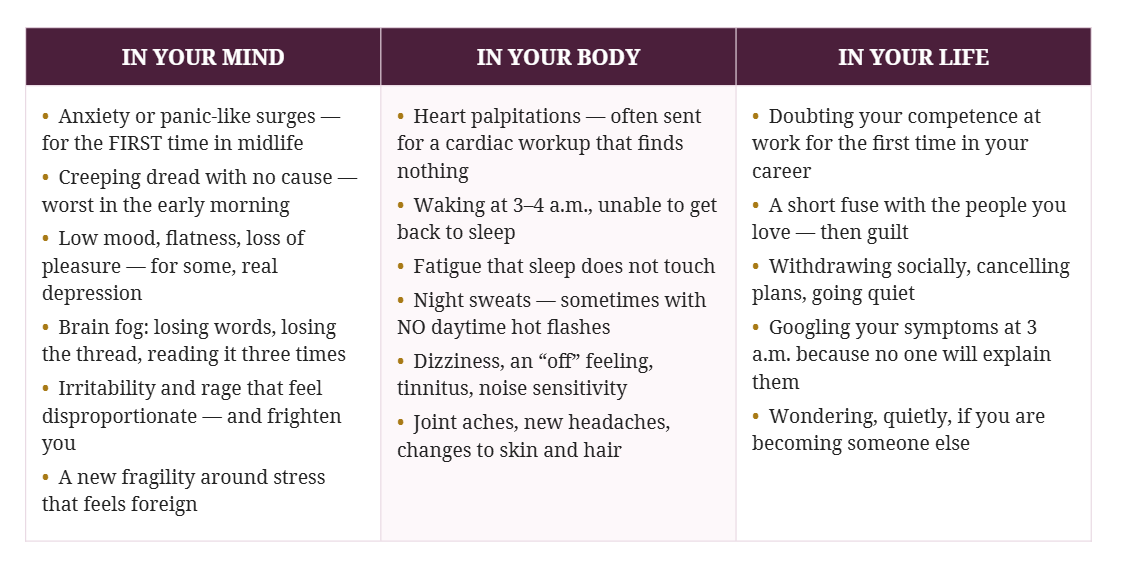
Symptoms of Perimenopause
If you are reading that list with a rising sense of recognition — that feeling is data. Write it down.
The four clues: how to actually tell the difference
Anxiety and perimenopause overlap enough to confuse trained clinicians, so do not feel foolish for not knowing. But there are four clues that point toward a hormonal root cause. Take them seriously, and take them together — no single one is proof, but three or four of them stacked is a strong signal.
Clue 1 — It is NEW in midlife
This is the loudest clue. Clinical anxiety disorders usually have a long track record; they tend to show up earlier in life and leave a trail. If you are 43 and you have never been an anxious person — if you were the calm one, the capable one, the one everyone else called in a crisis — and now you are waking at 3 a.m. with your heart hammering, that is not a personality that suddenly changed at 43. Something physiological changed.
Ask yourself plainly: was I like this at 30? At 25? If the honest answer is no, that matters enormously, and it belongs in your doctor’s ear.
Clue 2 — It is CYCLICAL
Hormonal anxiety tends to have a rhythm. It often worsens in the days before your period, or clusters unpredictably as your cycle becomes irregular. You might have two decent weeks and then a week where you feel like you are coming apart, and then it lifts — and you tell yourself you were being dramatic, because look, you are fine now.
You were not being dramatic. You were tracking a hormone. Generalized anxiety does not usually take a week off and come back on schedule.
Clue 3 — It travels with physical company
Pure anxiety does not typically bring night sweats. It does not usually change your menstrual cycle. So look at what is riding alongside the dread: are you also having palpitations, 3 a.m. wake-ups, night sweats, joint aches, brain fog, cycle changes, new headaches?
The more physical passengers in the car, the more likely the driver is hormonal. Anxiety is a passenger here — not the driver.
Clue 4 — Treatment only half-works
This is the clue that gets missed most often, and it is the one that should send you back to the office. If you have been prescribed an antidepressant or anti-anxiety medication and it has taken some edge off but the palpitations continue, the 3 a.m. wake-ups continue, the night sweats continue, the fog continues — that partial response is information.
A treatment aimed at the wrong root cause often produces exactly that: partial relief, persistent physical symptoms, and a woman who concludes she must be a difficult case. You are not a difficult case. The target may simply be wrong.
One essential caveat: these are not either-or. Perimenopause can genuinely cause anxiety and depression by disrupting the very systems that regulate mood. A woman can have a real anxiety response AND a hormonal driver underneath it — and she may need support for both. The goal is not to trade one label for another. It is to make sure nobody stops looking after the first one.
Your five-minute self-assessment
Go through this honestly. Check every box that is true for you in the last six months. Then count them — and take this page with you to your appointment.
Section A — The pattern
☐ My anxiety or low mood appeared for the first time in my late 30s, 40s, or 50s.
☐ I was not an anxious person before this.
☐ My symptoms come and go — some weeks are much worse than others.
☐ My worst weeks seem to cluster around my cycle (or my cycle has become unpredictable).
Section B — The physical company
☐ I wake between 2 and 4 a.m. and cannot get back to sleep.
☐ I get heart palpitations or a racing heart, sometimes for no reason.
☐ I have night sweats — even if I do not get daytime hot flashes.
☐ I have brain fog: losing words, losing my train of thought, forgetting why I walked in here.
☐ My periods have changed — heavier, lighter, closer together, further apart, or skipping.
☐ I have new joint aches, headaches, or a general “off” feeling.
Section C — The response
☐ I have been told this is anxiety, stress, depression, or “just your age.”
☐ I have been prescribed something for mood — and it has only partly helped.
☐ The physical symptoms are still there, even if my mood improved somewhat.
☐ No doctor has ever raised perimenopause with me.
How to read it: if you checked several boxes in Section A and Section B — especially the “new in midlife,” the cyclical pattern, and the 3 a.m. wake-ups — you have a genuine, evidence-based reason to ask your doctor to evaluate you for perimenopause. Boxes checked in Section C tell you something else: that the system has already looked at you once and stopped too early.
The appointment script: exactly what to say
Most women lose the appointment in the first ninety seconds — not because they are inarticulate, but because they lead with the emotional symptoms, and the moment a clinician hears “I have been anxious and weepy,” the anxiety pathway opens, and the hormonal one closes.
So invert it. Lead with the physical. Physical symptoms are harder to wave away.
Open with this
“I’m here because of a cluster of physical symptoms. I’m waking at 3 a.m. with heart palpitations. I’m having night sweats. My cycle has changed. I have brain fog and joint aches. And alongside all of that, I’ve developed anxiety I have never had before in my life.”
Then ask the question directly
“I believe this may be perimenopause. I’d like to rule that in or out before we treat it as a mental health condition.”
That sentence does an enormous amount of work. It reframes the visit from “woman with a vague complaint” to “patient with a specific clinical question that has to be answered.” It is very hard to ignore.
Ask for these specifics
● A full symptom review in the context of the menopausal transition — not a depression screen in isolation.
● Thyroid function tests and iron/ferritin, to rule out the common mimics. (Do not skip this — thyroid disease and anemia can look strikingly similar, and you deserve to have them excluded.)
● A conversation about your options if this is hormonal — including whether menopausal hormone therapy is appropriate for you, and what the non-hormonal options are.
A word on testing, so you are not blindsided: there is no single blood test that reliably diagnoses perimenopause, because your hormone levels are swinging so wildly that a snapshot means very little. Perimenopause is largely a clinical diagnosis — made from your symptoms, your age, and your cycle history. So if someone tells you “your hormone levels came back normal, so it is not perimenopause,” that is not correct, and you can say so.
If you are dismissed
It happens. Have this ready, and say it calmly:
“I’d like it noted in my chart that I raised perimenopause and that we did not evaluate it. And I’d like a referral to a menopause specialist.”
Asking for something to be documented in the chart changes the temperature of a room — not as a threat, simply as a patient who is keeping a record. And you have a real fallback: The Menopause Society maintains a directory of certified menopause practitioners at menopause.org. A clinician who has specifically trained in this will not need to be convinced that your symptoms are real.
What actually helps while you are waiting
Appointments take weeks. Here is what the evidence supports that you can begin tonight — not as a substitute for care, but so you are not simply enduring.
● Track everything, starting today. Date, symptom, severity, time of day, and where you are in your cycle. Two to three months of this is the single most powerful thing you can put in front of a doctor — it converts “I don’t feel like myself” into a pattern that is very hard to dismiss.
● Protect the 3 a.m. window. Cool, dark room. Consistent wake time even after a bad night. Get bright light into your eyes early in the morning — it helps re-anchor a cortisol rhythm that has drifted. And be honest about alcohol: it is a reliable route to a 3 a.m. wake-up, because it fragments the second half of the night.
● Strength train. Two or three times a week. Resistance training is one of the best-studied tools for regulating the stress response — and it protects the muscle and bone you begin to lose as estrogen falls. This is not the same advice as “do more cardio.”
● Ten minutes of stillness. A 2025 meta-analysis of 18 randomized controlled trials — 1,572 women — found that mind-body practices produced moderate-to-large improvements in anxiety, depression, and sleep during the menopausal transition. That is not “just relax.” That is a measurable intervention.
● Eat for stable blood sugar. Protein at every meal. Blood-sugar crashes and cortisol spikes are close cousins, and a crash at 4 p.m. can feel indistinguishable from an anxiety attack.
● Tell one person the truth. Not a performance of coping — the actual truth. The isolation of this stage does real damage, and naming it out loud to one trusted person takes a surprising amount of the charge out of it.
Why this keeps happening to us
You may be wondering how something this common could be missed this consistently. It is a fair question, and it has an answer.
Nearly 40% of women feel they were misdiagnosed during perimenopause, according to a 2025 national survey of more than 1,000 U.S. women, commissioned by the hormone-health company Biote. One in three was diagnosed with anxiety. Nearly 39% of the women who were medicated for depression or anxiety during this period did not believe the diagnosis was right. And more than 80% said they had little or no knowledge of what perimenopause symptoms even look like — which means they were not able to advocate for something they had never been told existed.
And you cannot advocate for something you cannot name. In a 2026 global survey published in Menopause, 34% of American women over 35 were not sure which reproductive stage they were even in — perimenopause, menopause, or postmenopause. A third of us are moving through the single biggest hormonal shift of adult life, without the vocabulary to say where we are.
A 2026 global survey by Newson Research — a self-selected online survey of 3,567 women across 71 countries — found that almost two-thirds had their symptoms attributed to other causes before they were treated correctly. More than 60% saw multiple healthcare professionals first. One in ten attended more than ten appointments.
And it is not because your doctor is careless. It is because a 2023 survey of OB/GYN residency programs found that only 31.3% included a menopause curriculum at all. Meanwhile, roughly 6,000 American women reach menopause every single day — and there are only about 1,300 certified menopause practitioners in the entire country.
You were not imagining it. The system simply was not built to find it.
This is part of a much older story — a century of medicine built on a body that was not yours, which is a story worth knowing in full, because it will explain more than perimenopause ever could. But the short version is this: nobody funded the research, so nobody wrote the textbook, so nobody trained the doctor who is sitting across from you now.
Which is exactly why you are going to have to walk in and name it yourself. And now you can.
The bout of depression I never saw coming
I want to tell you something before you go, because I think it might be the most useful thing in this entire article.
A few years ago, I went through the hardest professional stretch of my life. The details do not matter here — what matters is that it was genuinely, objectively awful. And during it, I experienced something I had never experienced before: a real bout of depression. I was waking in the middle of the night, over and over, running through my next moves in the dark like a chess player who had lost the board. I have never been that person. I have always been the capable one.
Here is the trap I want you to see, because I walked straight into it.
I had an obvious reason to feel terrible. Everyone around me had an obvious reason to explain it. Of course you are struggling — look at what you are going through. So nobody asked the other question. Not my doctor. Not my friends. Not me.
When there is an obvious external cause, nobody looks for the hormonal one underneath it. That is how perimenopause hides in plain sight.
The stress was real. But I have come to believe, looking back with everything I now know, that the hormonal transition I was moving through was part of what made me so vulnerable to it — that it lowered the floor beneath me. I say “believe” deliberately: I cannot go back and prove it. But I can tell you the detail that stops me every time I think about it.
I have never had a bout of depression before that. And I have never had one since.
Never before. Never since. One episode, in exactly the window when my hormones were shifting under me — and a perfectly good external explanation sitting right there, ready to absorb all the blame so no one had to look any further.
If you are in a hard season right now — a brutal job, a divorce, a sick parent, a loss — and everyone keeps telling you that of course you feel this way, I want you to hear me: they may be right, and it may still not be the whole story. The stress can be real, AND your hormones can be part of why it is flattening you this completely, this time, in a way nothing ever flattened you before.
Ask the other question. Nobody is going to ask it for you.
The bottom line
Your symptoms are real. Your suffering is not a character flaw, a failure of resilience, or evidence that you have become someone weaker than you used to be.
If your anxiety appeared for the first time in midlife — if it moves with your cycle, if it arrives with a racing heart and 3 a.m. wake-ups and a fog you cannot think your way out of, and if the treatment you were given only half-worked — then you have every reason to walk back into that office and ask the question nobody has asked you.
You do not need permission. You need the words, and now you have them. You need the evidence, and now you can bring it.
You are not broken. You were never broken. You were just never asked the right question.
Take the self-assessment above to your next appointment — and grab the free 7-Day Symptom Tracker + Doctor Visit Guide at notcrazymovement.com/guide to build the evidence they cannot wave away.
You’re not crazy. You’re not alone. And you deserve an answer that actually fits.
— Delaney
Delaney Cassidy is the author of You’re Not Crazy... You’re Menopausal: Science, Strategies, and Swearing Through the Hormonal Apocalypse, available October 18, 2026, World Menopause Day.
-
Anxiety that appears for the first time in midlife, moves with your cycle, and arrives with 3 a.m. wake-ups, palpitations, or night sweats may be driven by perimenopause. In a 2026 Menopause study, perimenopausal women's psychological symptoms scored about 1.5× more severe than premenopausal women's.
Key takeaways:
• Perimenopausal women's psychological symptoms are ~1.5× more severe than premenopausal women's (Menopause, 2026).
• It is the fluctuation of estrogen, not the decline, that destabilizes mood, sleep, and the stress response.
• Four clues point to a hormonal root: it is new in midlife, it is cyclical, it travels with physical symptoms, and treatment only half-works.
• About 40% of women feel misdiagnosed in perimenopause; 1 in 3 is told it is anxiety (Biote, 2025).
• Perimenopause is a clinical diagnosis — “normal” bloodwork does not rule it out.
-
Yes. As estrogen fluctuates it stops reliably supporting serotonin, weakens GABA (the brain's calming signal), and leaves the alarm system firing — while cortisol runs high. New or worsening anxiety in midlife can be a hormonal symptom, not a personality change.
-
Look for four clues together: it is new in midlife, it is cyclical, it travels with physical symptoms (palpitations, night sweats, 3 a.m. wake-ups, brain fog), and prescribed treatment only half-works. Three or four stacked is a strong signal.
-
No single blood test reliably diagnoses it, because hormone levels swing wildly. It is a clinical diagnosis from symptoms, age, and cycle history — so “normal” labs do not rule it out.
-
Lead with the physical symptoms, then say: “I believe this may be perimenopause. I'd like to rule that in or out before we treat it as a mental health condition.”
-
es. Perimenopause can genuinely cause anxiety and depression, and a woman can have both at once and need support for both. The goal is to make sure no one stops looking after the first label.
-
Track symptoms for 2–3 months, protect the 3 a.m. window (cool room, consistent wake time, morning light, honest about alcohol), strength train, and eat for stable blood sugar.